Shizi by Paul Fischer
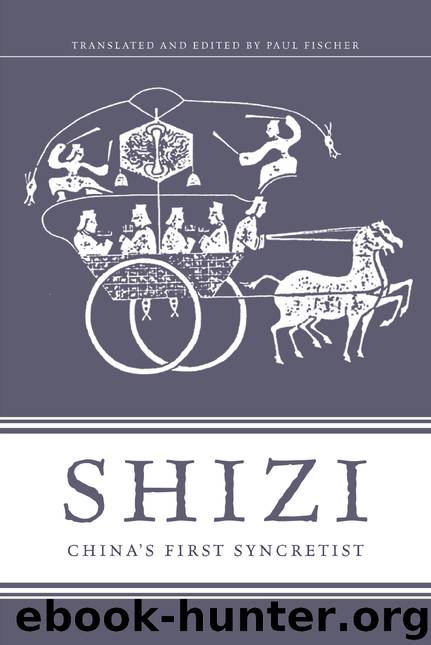
Author:Paul Fischer
Format: epub
Publisher: Perseus Books, LLC
Published: 2012-06-13T16:00:00+00:00
Notes
INTRODUCTION
1. “Ruism” is more commonly known in the West as Confucianism, but the latter is a misnomer, not unlike the now-discarded Western practice of referring to Islam as “Mohammadism.”
2. Most dates for early Chinese masters are from Qian Mu (1895–1990), Xian Qin zhu zi xi nian (Chronology of Pre-Qin Masters; 1935) (repr., Beijing: Shangwu yinshuguan, 2001), 693–698.
3. “Composite and fractured” refer to the practice of early authors to borrow from one another and to the central role that early editors had in the evolution of a text. The reference to other texts that use similar sayings noted in this translation, and the significant number of isolated fragments in the appendix, give a rather different—and more accurate—impression of the state of early Chinese texts than is usually presented to students.
4. For one example of this, see Judith Berling, The Syncretic Religion of Lin Chaoen (New York: Columbia University Press, 1980).
5. For more on the Taiping jing, see Barbara Hendrishke, The Scripture on Great Peace: The Taiping jing and the Beginnings of Daoism (Berkeley: University of California Press, 2007).
6. Kong Zi is better known in the West as Confucius, but I use the former nomenclature to highlight his status as one of a class of many masters.
7. Despite recent attempts by some Western anthropologists who take their cue from modern revisionist believers rather than from the historical record, it remains the case that these two traditions differ far more than they agree. For example, religious Daoism has the usual religious provisions for gods, revelation, priests, faith, sin, atonement, and eschatological predictions, while Daoist philosophy has none of these. For an example of the former view, see Russell Kirkland, Taoism: The Enduring Tradition (New York: Routledge, 2004).
8. This commentary was translated by Stephen Bokenkamp in his Early Daoist Scriptures (Berkeley: University of California Press, 1999).
9. A “Masters” text refers to an early Chinese textual category used in library catalogs. From 6 BCE to 279 CE, imperial library catalogs used six categories: 1. Classics (), 2. Masters (), 3. Poetry (), 4. Military writings (), 5. Cosmology (), and 6. Anthropology (). This is the earliest known catalog system in China and was invented by Liu Xin (45 BCE–23 CE), who used it in his Qi lüe (Seven Summaries; 6 BCE). After 279 CE, imperial library catalogs have four categories: 1. Classics (), 2. Masters (), 3. History (), and 4. Literature (). These categories are still in use today and were invented by Xun Xu (231–289), who used it in his Zhong jing xin bu (New Register of Imperial Classics; 279 CE).
10. The Masters () category of the imperial library catalog was subdivided into ten types: Ruist (), Daoist (), Yin-Yang (), Legalist (), Designative (), Mohist (), Diplomatic (), Syncretist (), Agriculturalist (), and Miscellaneous (). The Syncretist subcategory is defined thus: “Syncretists probably emerged from the Councilor office. (They) combine Ruism and Mohism, unite Designatism and Legalism, know that (proper) state formation has (all) these, and see that (proper) kingly government is entirely interconnected: these are its strengths.
Download
This site does not store any files on its server. We only index and link to content provided by other sites. Please contact the content providers to delete copyright contents if any and email us, we'll remove relevant links or contents immediately.
| Anthropology | Archaeology |
| Philosophy | Politics & Government |
| Social Sciences | Sociology |
| Women's Studies |
The remains of the day by Kazuo Ishiguro(9009)
Tools of Titans by Timothy Ferriss(8406)
Giovanni's Room by James Baldwin(7359)
The Black Swan by Nassim Nicholas Taleb(7142)
Inner Engineering: A Yogi's Guide to Joy by Sadhguru(6802)
The Way of Zen by Alan W. Watts(6623)
The Power of Now: A Guide to Spiritual Enlightenment by Eckhart Tolle(5795)
Asking the Right Questions: A Guide to Critical Thinking by M. Neil Browne & Stuart M. Keeley(5783)
The Six Wives Of Henry VIII (WOMEN IN HISTORY) by Fraser Antonia(5522)
Astrophysics for People in a Hurry by Neil DeGrasse Tyson(5197)
Housekeeping by Marilynne Robinson(4459)
12 Rules for Life by Jordan B. Peterson(4316)
Ikigai by Héctor García & Francesc Miralles(4281)
Double Down (Diary of a Wimpy Kid Book 11) by Jeff Kinney(4280)
The Ethical Slut by Janet W. Hardy(4266)
Skin in the Game by Nassim Nicholas Taleb(4260)
The Art of Happiness by The Dalai Lama(4135)
Skin in the Game: Hidden Asymmetries in Daily Life by Nassim Nicholas Taleb(4015)
Walking by Henry David Thoreau(3973)
